
Choosing Between Liquid and Air Cooling for Your Facility
With the rapid advancement of technologies like AI and cloud services, traditional air cooling systems are under significant pressure to maintain optimal temperatures for densely packed data centers. As outlined in Vertiv’s Data Center Trends 2025 report, future projections show that average rack densities may reach up to 1000kW in AI facilities. Such high-density environments necessitate advanced cooling solutions to avoid overheating and prevent costly downtime.
Understanding Liquid and Air Cooling Mechanisms
Cooling your data center is crucial for maintaining operational stability. Equipment generates heat that must be properly dissipated to avoid failures. Both air cooling and liquid cooling remove this heat, but each uses a distinct approach. Air cooling employs air circulation to transfer heat away from equipment, making it suited for lower density setups. Solutions like precision air systems offer comprehensive cooling by targeting specific racks, rows, or entire rooms. Systems such as the Liebert PDX Compact DX or Liebert CW Chilled Water System demonstrate these capabilities.
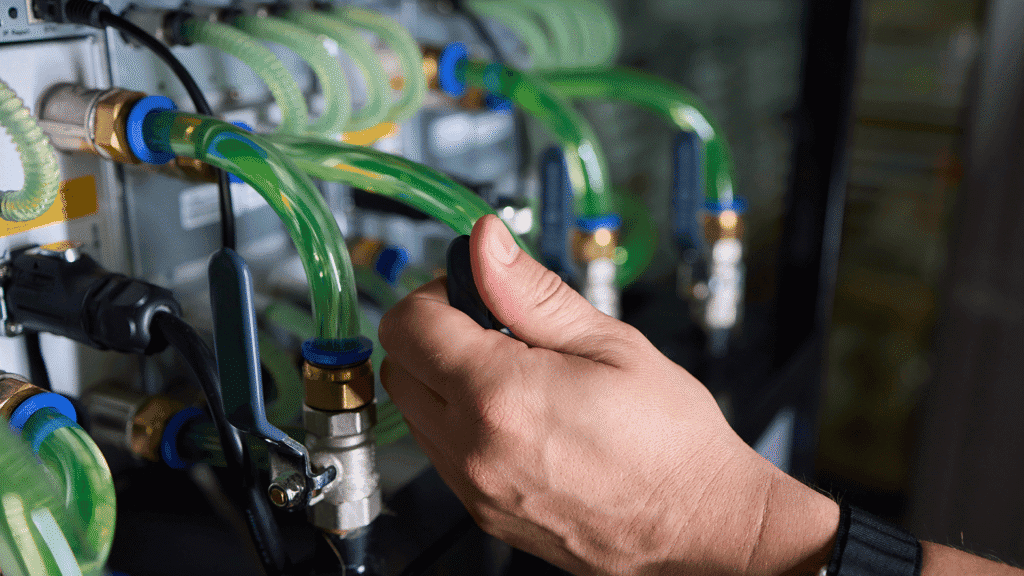
Liquid cooling, on the other hand, directly uses water or specially formulated nonconductive liquids to absorb and dissipate heat. This method is more effective in high-density environments, as liquid is a superior medium for heat exchange. Three main liquid cooling techniques include:
- Direct Cooling to Chips: Utilizes coolants that directly interact with server chips, as seen with the Vertiv CoolChip CDU.
- Rear Door Heat Exchangers: These are installed on server racks’ back panels to intercept heat emitted by servers, like the Liebert DCD Rack Door.
- Immersion Cooling: Involves submerging entire servers in a nonconductive liquid to absorb generated heat efficiently.
Selecting the Right Cooling Solution for Your Data Center
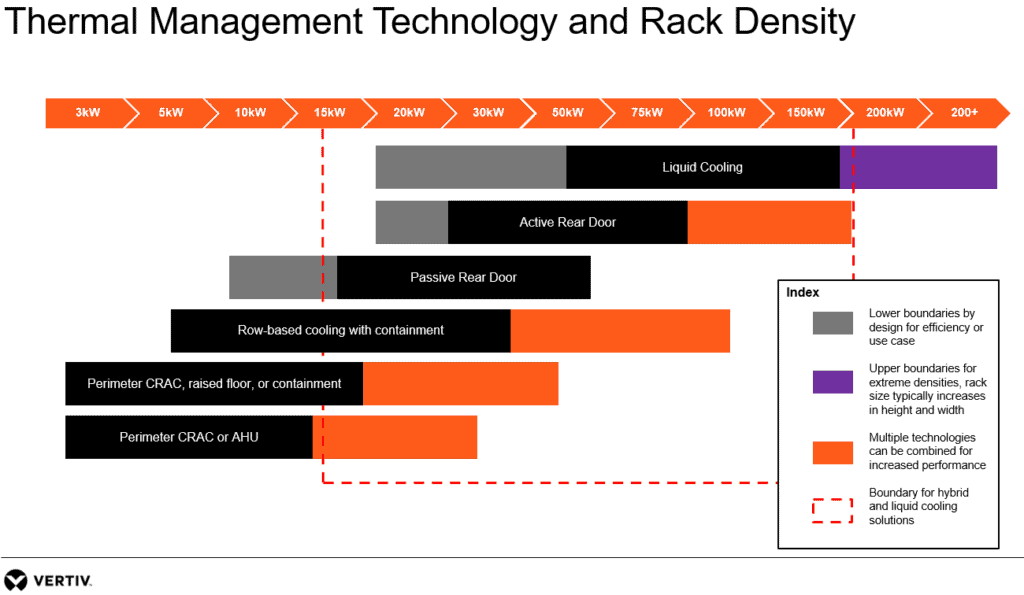
Your choice of cooling solution should align with your facility’s rack density. For racks under 20kW, air cooling typically suffices due to lower power and heat levels. Options like the Liebert DS Expansion System efficiently replaces warmed air with cooled air. Conversely, racks above 20kW might necessitate liquid cooling solutions. At 30kW or beyond, liquid cooling becomes crucial for managing the increased heat load, as traditional air methods struggle with this level of thermal output.
Consider a hybrid approach that combines both air and liquid cooling to maximize efficiency. Products like the Vertiv CoolChip CDU support this model by directing liquid to chip areas while air conditioning maintains ambient temperatures. Such systems operate with reduced energy consumption due to the use of pumps over compressors, further optimizing power usage.
Are You Ready to Optimize Your Facility’s Climate?
Creating an optimal environment for your IT equipment involves more than just regulating temperature and humidity. It requires a strategic cooling setup that is both organized and adaptable to future technological changes. Stay informed on the latest cooling technologies and practices by subscribing to our newsletter, ensuring your facility remains at the forefront of efficiency. For personalized advice, don’t hesitate to contact us at 248-616-9200.
Frequently Asked Questions About Liquid Cooling
What is liquid cooling?
Liquid cooling involves using fluids like water or nonconductive liquids to absorb and dissipate heat from IT equipment.
Why choose liquid cooling over air cooling?
Liquid cooling is more efficient for high-density data centers as it handles greater heat loads, making it ideal for advanced IT operations.
Can liquid cooling save energy?
Yes, liquid cooling can reduce energy consumption as it requires fewer resources than traditional air cooling systems.
Is hybrid cooling effective?
Hybrid cooling combines air and liquid methods, enhancing heat management and reducing costs in high-density environments.
How do I know if my facility needs liquid cooling?
If your rack density exceeds 20kW, consider liquid cooling for effective thermal management and to prevent overheating.